
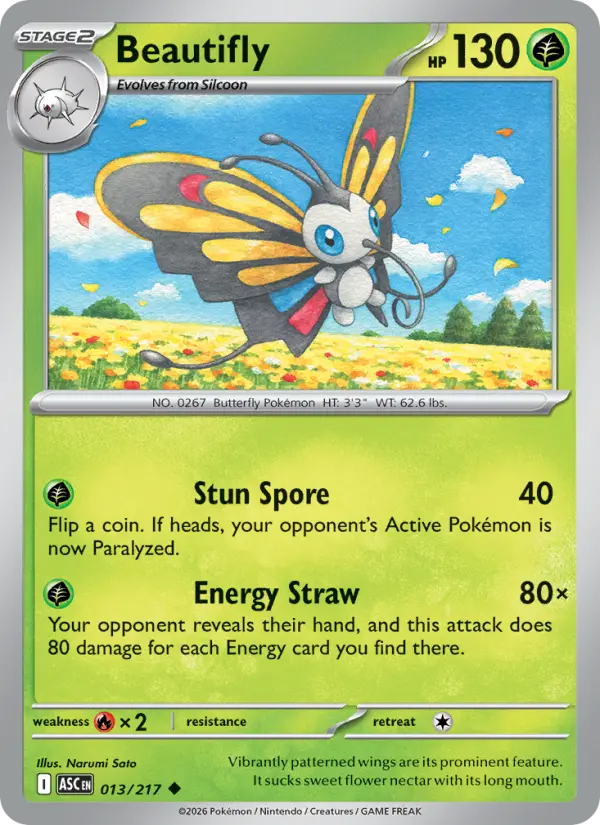
Card of the Week: Beautifly
Right now, the Reverse version of Beautifly sits in the cheap-but-interesting lane of the modern market. Third-party pricing pages currently place the regular Ascended Heroes Beautifly around $0.09 market price, while reverse-holo references are still generally a sub-£1-to-low-dollar card rather than a headline chase, which makes it much more of a binder and master-set target than a speculation piece. (tcgplayer.com)
That said, this is exactly the sort of card newer collectors often end up liking more than they expected. Beautifly is a Stage 2 Grass-type from Ascended Heroes, illustrated by Narumi Sato, and the reverse finish gives a normally modest species a bit more visual presence. If you collect for artwork, evolution lines, or full set completion rather than pure chase-card status, this reverse has a very clear role in the set. (midwestcards.com)
Why Beautifly still has a place
Beautifly has never been one of Pokémon’s loudest mascots, but it has a quiet charm that collectors tend to appreciate over time. In the games, it is the final evolution of Wurmple’s Silcoon branch, essentially the “graceful” counterpart to Dustox, so it carries that familiar early-route evolution nostalgia that many long-term fans remember from Hoenn.
That matters more than it might seem. Cards built around recognisable evolution stories often hold better collector affection than their raw market price suggests, because people are not only buying a single card, they are buying a little piece of the Pokémon journey they remember. Beautifly is not Charizard money, but it is exactly the kind of Pokémon that makes a binder page feel more personal.
The reverse version’s real appeal
For this specific card, the main collectibility angle is not rarity hype. It is format and finish. Reverse holos in modern sets often end up serving two audiences at once: master-set builders who need every variant, and artwork-first collectors who simply prefer the shimmer on a standard card frame.
Beautifly benefits from that more than some bulk-adjacent cards because it is a Stage 2. Stage 2 Pokémon tend to feel more “complete” in a collection, especially when you enjoy organised evolution pages in a binder. A reverse-holo Stage 2 also tends to read as a little more premium than a reverse of a basic common, even when the actual price gap is modest.
How much is Beautifly Reverse worth right now?
The short answer is: not much in cash terms, but more than bulk in collector usefulness.
Live market references for the regular 013/217 Beautifly show an extremely low floor, with TCGplayer listing a market price around $0.09, while other pricing trackers place the reverse holo at roughly $0.24 and indicate that reverse-specific listings do exist for the card. That puts Beautifly Reverse firmly in affordable territory, especially compared with the set’s Illustration Rare Beautifly #219, which is tracking closer to the $8 to $9 range. (tcgplayer.com)
That price spread is useful context. It tells you collectors clearly prefer the more dramatic Illustration Rare version when they want a Beautifly centrepiece, but it does not make the reverse irrelevant. It simply places the reverse in a different collector lane: completion, variant collecting, and low-cost set building.
A small confusion worth knowing
This is one of the few genuinely specific buying points for the card. Ascended Heroes Beautifly exists both as the standard set card #013/217 and as a separate Illustration Rare #219/217, and search results can mix them together very easily. (pricecharting.com)
If you are hunting the Reverse version, make sure the listing is clearly for 013/217 and not the much pricier #219 card. That sounds obvious, but Beautifly is one of those Pokémon where the cheaper reverse and the more desirable art card can blur together in marketplace searches, especially when sellers use short titles.
Where the market sits now
The broader Ascended Heroes cards market still has that modern-set pattern where a small number of eye-catching chase cards absorb most of the attention, while reverses and non-chase evolution cards stay very accessible. Collector chatter around Ascended Heroes has also reflected a mix of admiration for the set’s artwork and a practical preference for buying singles rather than endlessly opening sealed product, especially once release hype cooled. (reddit.com)
That backdrop actually suits Beautifly Reverse quite well. When a set has expensive centrepieces, affordable variants become easier to appreciate on their own merits. You are not paying a premium for hype here; you are paying a very small amount for a tidy, visually nicer version of a Hoenn evolution line card.
Is Beautifly Reverse worth collecting?
Yes, if your idea of collecting is broader than chasing the top five cards in a set.
Beautifly Reverse is worth collecting as a low-cost binder piece, a master-set necessity, and a nice-looking Stage 2 from a modern release. It is probably not the sort of card you stash away expecting a dramatic short-term jump, because the available pricing data still places it in the affordable, widely obtainable bracket. (thepricedex.com)
But that does not make it forgettable. Cards like this often become favourites because they are easy to overlook at first and then oddly satisfying to own once your set starts taking shape. If you like evolution lines, Grass types, or Narumi Sato’s softer illustration style, Beautifly Reverse makes more sense as a collection card than its tiny current price would suggest.