
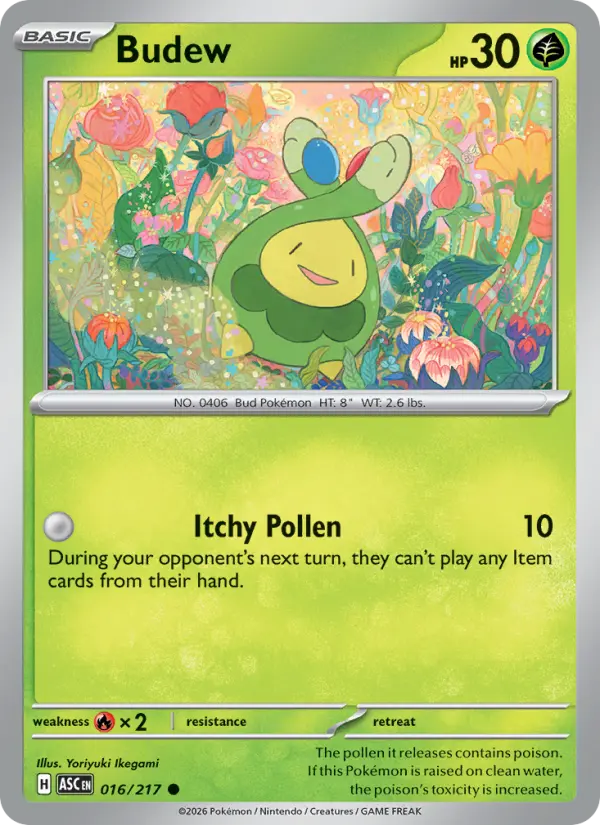
Card of the Week: Budew
Budew tends to sit in a surprisingly strong “easy-to-love” spot in the market right now: it’s a Common, but the Reverse pattern gives it that extra pop collectors actually notice when they’re flipping binder pages. On FetchGem, it’s card #016 from Ascended Heroes with artwork by Yoriyuki Ikegami, and it’s one of those low-cost pickups that still feels “premium” once you see the foil in hand. (fetchgem.com)
That matters more than you’d think in Ascended Heroes, a set that’s been pricey to open compared to many recent releases—ETBs and loose packs have been floating well above the “impulse buy” zone, which quietly supports demand for clean singles like this. (fetchgem.com)
Where Budew (reverse) sits in Ascended Heroes right now
Your first mental model for this card should be: not a chase card, but a high-visibility binder card. Reverse holos are often what make a set feel complete, and Budew’s art style (Ikegami’s softer, storybook-like look) plays especially nicely with the shimmer.
Ascended Heroes itself is also a “special set” style release, and it’s been expensive to open in the US/UK market. FetchGem’s pricing snapshot shows US Ascended Heroes ETBs around $113 on major marketplaces, and US booster packs around $11.48–$11.50; UK packs have shown a wide spread (roughly £5.99 at the low end when available, and higher at some retailers). (fetchgem.com)
When opening costs stay elevated, two things typically happen:
1) more people switch to singles to finish pages, and
2) “simple” reverse holos that look great in binders can stay more liquid than you’d expect for Commons.
Who Budew is in Pokémon lore (and why collectors care)
Budew was introduced in the Sinnoh era as the baby Pokémon that evolves into Roselia, and its whole identity is built around that “tiny but prickly” vibe. In the games and Pokédex flavor over the years, Budew’s pollen is frequently framed as both a defense mechanism and a sign of health—small Pokémon that can still irritate (or even poison) anything that doesn’t treat it gently.
That’s a big part of why Budew cards work so well as collectibles: it’s recognizable even if you aren’t deep into competitive play. It connects to a popular evolutionary line (Roselia → Roserade) and hits an evergreen theme for Grass types—nature that’s cute, but not harmless.
Ikegami’s illustrations usually lean into emotion and environment rather than “action poses,” and that’s perfect for Budew. Even when Budew cards aren’t rare, they can still feel like miniature story panels, which is exactly what many newer collectors enjoy about Pokémon TCG art.
Why the reverse holo variant is the one to own
On the Budew page, FetchGem lists three versions in Ascended Heroes: Normal, Holo, and Reverse. (fetchgem.com)
For most Commons, the “Normal” is the one you accidentally end up with a stack of. The Reverse, though, is the version that’s easiest to notice in a binder because the foil pattern catches light across the card (even when the Pokémon itself isn’t a flashy, high-rarity print).
One specific reason this matters in Ascended Heroes: because the set is expensive to rip, many collectors aren’t opening enough product to naturally accumulate full reverse-holo runs. That turns some reverses into annoying gaps later—Budew included—especially if you’re building a page that showcases the Grass line or you’re collecting by artist.
How much is Budew worth right now?
FetchGem doesn’t show a single “Budew Reverse market price” in the snippet we can see, but it does give you the most important context: the cost to open Ascended Heroes is still high, with packs around $11.48 in the US and ETBs around $113 in the US at last check. (fetchgem.com)
For a Common reverse holo, that usually translates to a familiar pattern:
- early on, reverses can be weirdly hard to find in clean condition because people treat Commons like “bulk,”
- then supply catches up as more product gets opened,
- and later, prices stabilize based on how many collectors try to complete reverse sets.
If you’re tracking value, your best move is to watch Budew reverse pricing relative to pack price: when packs remain expensive, “nice-looking reverses” tend to hold better than you’d expect.
The one Budew-specific “hunting” note (condition + confusion)
If you’re buying this card online or trading for it in person, the main gotcha isn’t authenticity or anything dramatic—it’s mix-ups between variants.
Because FetchGem lists Normal / Holo / Reverse for this exact card slot, it’s easy for listings to accidentally show a photo that doesn’t match the variant (especially when sellers use a generic image). (fetchgem.com)
So when you’re hunting:
- confirm the listing explicitly says Reverse, and
- make sure the photo shows the reverse foil pattern (not just a glossy scan of the artwork).
Also, reverse holos tend to show surface scratching more obviously under harsh lighting. Budew’s lighter, softer art makes those micro-scratches stand out, so “Near Mint” can look more like “Light Play” than you’d expect if the card’s been loose-stacked.
Why Budew (reverse) is worth collecting anyway
Not every “worth collecting” card has to be a headline hitter. Budew (Ascended Heroes, Reverse) is a great example of a card that earns its place through presentation and set context rather than raw rarity.
If you’re collecting Ascended Heroes in any structured way—by Pokédex, by type, by artist, or by reverse-holo completion—Budew is the kind of card you’ll be happy you grabbed early, in clean condition, instead of circling back later when you’re one page away from finished.
If you want to explore what else sits around it in the same release, you can browse the full set here: Browse Ascended Heroes cards, and keep an eye on the broader sealed market here: Ascended Heroes.